
Most bakery owners think of Instagram as a social platform — a place to post photos, build followers, and stay visible with existing customers. But since July 2025, Instagram became something else entirely: a search engine asset. Your posts, Reels, and captions can now appear directly in Google results, right alongside websites, blogs, and local listings. The problem is that most bakeries are still posting like nothing changed — and that gap is costing them customers they never even knew they could reach.
This isn’t about posting more. It’s about understanding what Google is actually reading when it looks at your Instagram — and why a caption that says “Fresh croissants today! ✨” is invisible to every single person searching for a bakery in your neighborhood.
Table of contents
- What changed in July 2025 — and why it matters for local bakeries
- The search behavior your bakery is missing right now
- Why most bakery Instagram content is search-invisible
- The 3 gaps that make your posts disappear from Google
- What this reveals about your broader content strategy
- The real question your Instagram content should be answering
What changed in July 2025 — and why it matters for local bakeries
On July 10, 2025, Instagram began allowing Google, Bing, and other search engines to index public content from professional accounts — photos, videos, Reels, and carousels posted after January 1, 2020. If your account is a public business or creator profile, your content is now eligible to appear in Google search results by default.
This isn’t a minor update. For years, Instagram operated as a closed ecosystem: your posts reached followers and the Explore page, but they were largely invisible to anyone searching on Google. That wall is gone.
Here’s why this is specifically significant for bakeries: local search is one of the highest-intent categories in consumer behavior. According to Google, 76% of people who conduct a local search visit a business within 24 hours. These aren’t casual browsers — they are people actively looking for somewhere to go, often within the same day.
Your Instagram is now part of that search landscape. The question is whether it’s working for you or against you.
The search behavior your bakery is missing right now
Before diagnosing the content problem, it helps to understand who is actually searching — and what they’re looking for.
According to BrightLocal’s 2024 Consumer Behavior Index, 80% of US consumers search for local businesses online at least once a week, and 32% do so daily. At the same time, 67% of consumers between 18 and 24 already use Instagram to find local business information — a percentage that continues to grow year over year.
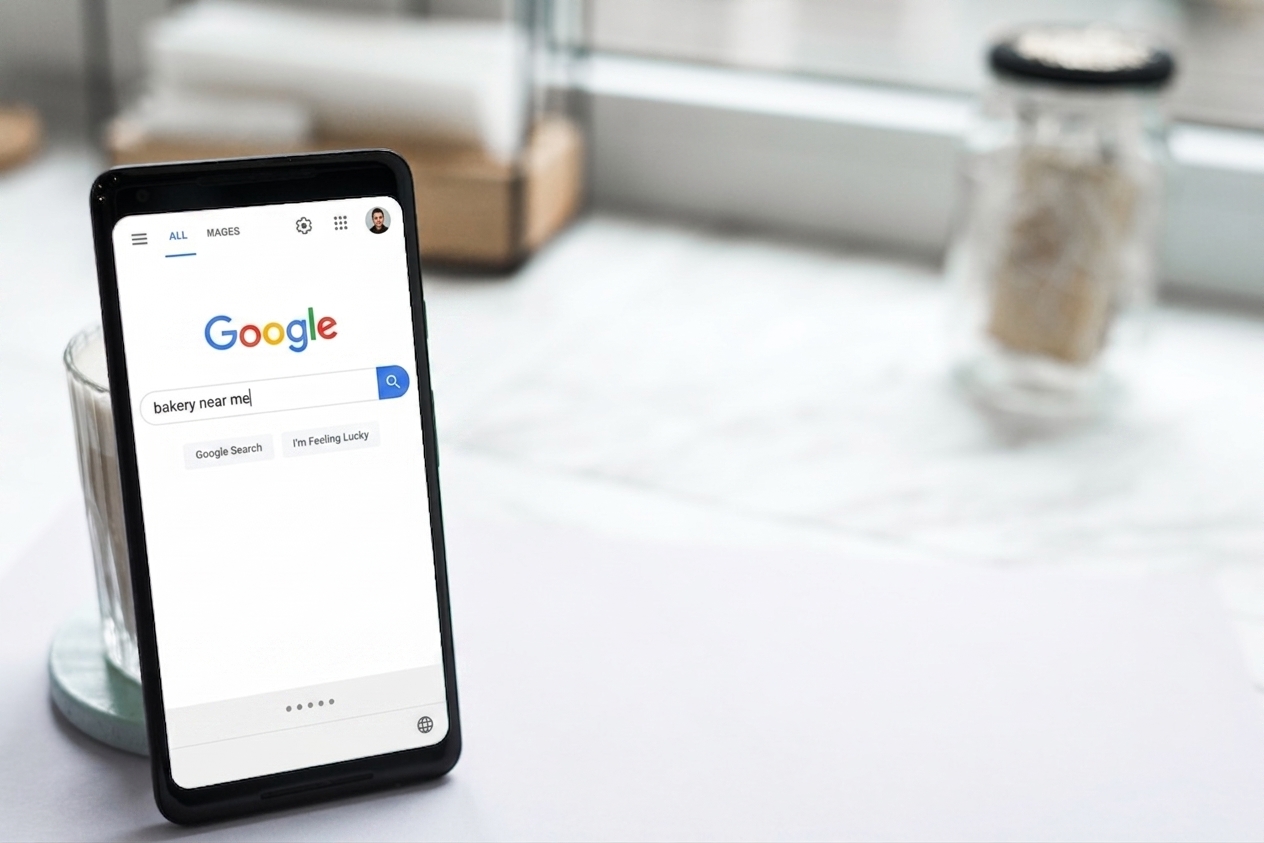
Here’s the diagnostic question: when someone in your city searches “artisan bakery near me” or “sourdough bread [your neighborhood]” on Google, what do they find?
- Open a private browser window right now.
- Search for your bakery’s category and city.
- Look at what appears.
- If your Instagram posts are visible, read the first line of the caption Google is showing.
Does it tell a potential customer anything meaningful about who you are and what you offer? Or does it say something like “Weekend vibes 🧁” or “Can’t wait for you to try this”?
Most bakery owners who do this exercise discover the same thing: their Instagram content, as currently written, communicates nothing to someone who doesn’t already know them. It’s written for followers, not for searchers.
Why most bakery Instagram content is search-invisible
The core issue isn’t effort or aesthetics. Most independent bakeries produce genuinely beautiful content — the photos are warm, the products are stunning, the feed has personality. The problem is structural.
Instagram content has historically been optimized for one thing: emotional resonance in the moment. A caption like “Sunday mornings were made for this 🍞” works perfectly inside the app. It creates feeling, invites engagement, fits the rhythm of scrolling. But Google doesn’t experience emotion. It reads text and makes decisions based on whether that text answers a real search query.
Here’s why this matters behaviorally: when someone searches “best sourdough bakery Chicago,” Google is trying to match intent with content. It’s looking for signals that tell it your post is relevant to that query — your location, your product category, descriptive language about what you make and how you make it. A caption with zero geographic or product-specific language gives Google nothing to work with. The post exists. It just doesn’t rank.
This isn’t a failure of creativity. It’s a failure of translation — between content designed for social consumption and content that can function inside a search ecosystem.
The 3 gaps that make your posts disappear from Google
Across independent bakery profiles, the same structural gaps appear consistently. These aren’t about posting frequency or follower count. They’re about how content is built.
Gap 1: Captions with no geographic or product specificity
When Google indexes your Instagram post, the caption is one of the primary signals it reads. A caption that contains your city name, neighborhood, and specific product category gives the algorithm something to match against local search queries. A caption that doesn’t include any of those signals gives Google nothing — and your post will not surface when someone nearby is actively searching.
The issue isn’t that bakery owners don’t know their location or their products. It’s that they’ve never thought of their caption as something a search engine would read. Once that shift happens, the fix is relatively straightforward — but the strategic decision to make that shift requires understanding why the current approach isn’t working.
Gap 2: Alt text left empty or auto-generated
Instagram allows you to add custom alt text to every photo and video. Almost no independent bakery does this. When left empty, Instagram auto-generates a generic description (“image may contain: food, pastry”) that has no keyword value whatsoever for search purposes.
Custom alt text — a short, descriptive sentence that includes your product name, city, and relevant keywords — is one of the clearest signals you can send to Google about what your content is. It’s invisible to your followers but fully readable by search engines. It’s also one of the least-used optimization tools in the entire local business content landscape.
Gap 3: No location data embedded in posts
Geotagging — adding a specific location to your posts — tells both Instagram and Google where your content is geographically anchored. For local businesses, this is a direct path to appearing in location-specific searches. Bakeries that geotag consistently give Google a continuous thread of location signals across their content history. Bakeries that don’t are essentially publishing without an address.
Combined, these three gaps mean that a bakery could be posting daily, consistently, with beautiful content — and still be completely invisible to every potential customer searching for exactly what they offer.
What this reveals about your broader content strategy
The Instagram indexing update is important, but it’s a symptom of a larger strategic question: is your digital presence built around how your customers find you — or around how you like to present yourself?
These two things are not always the same.
A bakery owner who invests heavily in aesthetics, consistency, and emotional storytelling is doing something genuinely valuable. That investment builds brand recognition, customer loyalty, and community. But if that same investment produces zero search-visible content, it’s not doing the full job. It’s building a relationship with people who already know you, while leaving an entire channel of discovery untouched.
The businesses that will benefit most from the Instagram indexing shift are the ones that understand content has always had two audiences: the humans scrolling inside the app, and the algorithms deciding who gets found outside of it. Building for both doesn’t mean writing robotic, keyword-stuffed captions. It means understanding the mechanics well enough to serve both audiences at once — which is a skill, not a formula.
The real question your Instagram content should be answering
You’ve built something worth finding. The question is whether someone who doesn’t already know you can actually find it.
Every piece of content your bakery publishes is an opportunity to answer a question that a potential customer is actively asking somewhere on Google. “Where can I find fresh sourdough in [your neighborhood]?” “Best birthday cake bakery in [your city]?” “Artisan croissants near me?” These searches happen thousands of times a day in every metropolitan area in the United States. The bakeries that show up are not always the best ones — they’re the ones whose content is structured to be found.
You’ve invested in your craft, your space, and your brand. That investment deserves to be visible not just to the customers who already follow you, but to every person in your city who is actively looking for exactly what you make.
Translating that into a content strategy that works across both social and search is not something that happens by accident. It requires understanding how search engines read content, how to build for both audiences without sacrificing authenticity, and where the specific gaps in your current presence are costing you visibility. That’s the kind of diagnostic work that turns a beautiful Instagram into a discovery engine — and a discovery engine into consistent new customers walking through your door.
Strategy for Bakeries helps independent bakeries build digital strategies that are as intentional as the products they make. If you’d like a clearer picture of where your online presence stands, send us an email — we’d love to hear about your bakery.