

We took on a client we almost didn’t know how to describe.
A bakery on an island in Alaska. A small town. A founder whose identity and her brand’s identity were nearly indistinguishable. A community where the bakery wasn’t just a business — it was part of the rhythm of the place.
We knew it would be a different kind of project. We didn’t know it would change how we think about bakery marketing strategy altogether.
Table of contents
- The problem with marketing that travels too easily
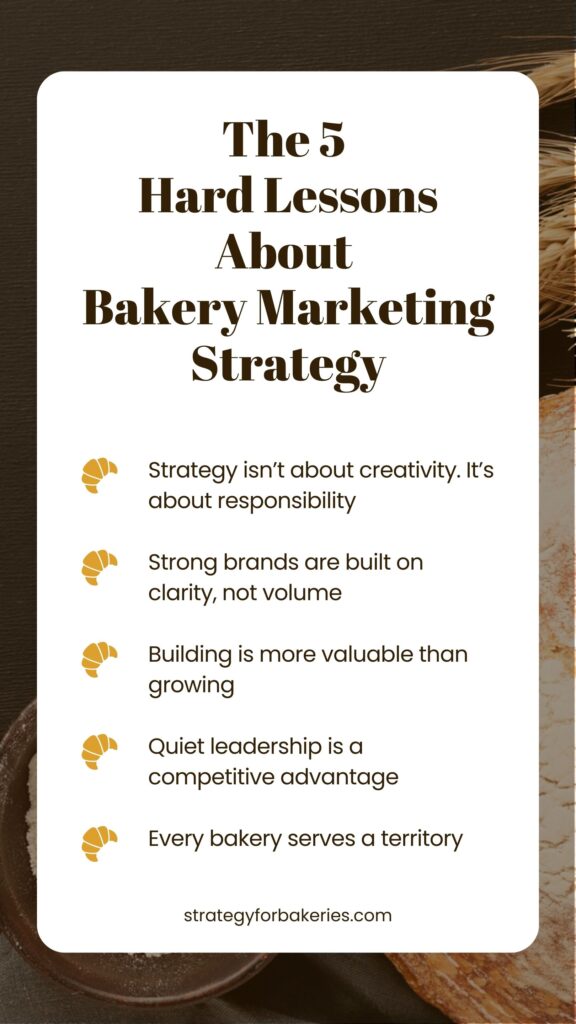
- Lesson 1: Strategy isn’t about creativity. It’s about responsibility.
- Lesson 2: Strong brands are built on clarity, not volume
- Lesson 3: Every bakery serves a territory
- Lesson 4: Building is more valuable than growing
- Lesson 5: Quiet leadership is a competitive advantage
- What this changes
The problem with marketing that travels too easily
Most marketing frameworks are designed to be portable. You learn a system, apply it across clients, adjust the variables. That efficiency is part of the appeal — for agencies and for the bakery owners who hire them.
The problem is that portable frameworks tend to flatten what’s most distinctive about a business. They optimize for reach before they understand what’s worth reaching people with.
Working with a bakery in a remote Alaskan community forced us off that track entirely. There was no template that fit. The usual metrics felt beside the point. And that friction turned out to be one of the most instructive experiences we’ve had as a team.
These are the five things it taught us.
Lesson 1: Strategy isn’t about creativity. It’s about responsibility.
When you work with a bakery in a major city, there’s room to experiment. Post something that underperforms, adjust the approach, try again. The margin for error is relatively wide.
That margin shrinks considerably when the bakery you’re working with is embedded in a small, tight-knit community — where the brand has been a consistent presence for years, where customers are also neighbors, and where trust is the primary currency.
In that context, every content decision carries different weight. We weren’t testing for engagement. We were helping to protect something that already had real meaning in people’s lives.
That distinction reshaped how we think about our role. Good bakery marketing strategy isn’t the most creative approach — it’s the most coherent one. The one that reinforces what’s already true about the brand rather than inventing something new to say.
- Coherence over cleverness
- Protecting existing trust over chasing new attention
- Consistency as the primary strategic tool
Lesson 2: Strong brands are built on clarity, not volume
Crystal’s bakery — the founder we worked with — didn’t need to post every day. Didn’t need to chase trending audio. Didn’t need to prove anything to anyone about being modern or relevant.
What she needed was for every piece of content to make it clearer who she was.
That sounds simple. It isn’t. Most bakery owners, when pressed to articulate their brand in specific terms, find the exercise harder than expected. Not because they don’t know their business — they know it intimately — but because translating lived identity into communicable brand language is a different skill entirely.
Working through that with her forced us to ask the questions we should be asking every client:
- What do you stand for, specifically?
- What would you never do, even if it performed well?
- What does your customer believe about you that you need to protect?
Without answers to those questions, any strategy is improvisation. The content might look fine. But it won’t build anything.
Lesson 3: Every bakery serves a territory
Kodiak Island isn’t just a geographic location. It’s an ecosystem with its own logic — seasonal rhythms, tourist flows, weather patterns, community rituals, economic realities.
All of that shapes how the bakery should communicate. What’s relevant in October isn’t relevant in May. What resonates with a longtime local is different from what lands with a visitor. The cadence of the community has its own tempo, and the brand needs to move with it.
This is something generic marketing ignores almost entirely. Templates don’t account for territory. Frameworks built for urban markets don’t ask what happens when the ferry doesn’t run, or when the fishing season ends, or when the same hundred people walk past your window every single day.
Good bakery marketing strategy is always local before it’s anything else. Not in a superficial “support local” sense — but in the deeper sense of understanding the specific ecosystem a business operates within and building communication that reflects that understanding.
Lesson 4: Building is more valuable than growing
There’s significant pressure in the marketing world — and we’ve felt it ourselves — to optimize for growth. More followers, more reach, higher engagement rates, faster results.
That pressure can lead agencies to push clients toward strategies that produce visible numbers quickly, even when those strategies aren’t right for the business.
With this client, the most valuable work we did was nearly invisible from the outside. Tightening the brand voice. Clarifying the visual identity. Making sure every post felt like it came from the same place, the same values, the same person.
No single piece of that work produced a spike in a dashboard. But together, it built something more durable than reach: perception. And perception, accumulated over time, becomes the kind of brand equity that’s very hard to undo — or to replicate.
Not every bakery needs to grow fast. Some need to grow solid. The difference matters, and it’s one of the first strategic questions worth asking.
Lesson 5: Quiet leadership is a competitive advantage
Crystal runs her bakery with what we’d describe as confident stillness. She isn’t loud about what she does. She doesn’t perform her values — she operates from them. The brand reflects that.
There’s something strategically powerful about businesses that operate this way. They don’t need to announce themselves constantly because their presence is already consistent. Customers don’t discover them so much as recognize them.
We’ve started thinking about this as a model worth examining for any bakery owner who feels the pressure to be everywhere, say everything, stay constantly visible.
The question isn’t whether you need to be louder. It’s whether you’re consistent enough that being quieter would actually work in your favor.
For many artisan bakeries — ones with real craft, real community, and real identity — the answer is yes.
What this changes
Working with a bakery on an island in Alaska pulled us out of autopilot.
It reminded us that bakery marketing strategy isn’t a set of tools applied to a business. It’s a way of thinking that has to be rebuilt from the ground up for every client — shaped by who they are, where they operate, who their customer is, and what they’re trying to build over time.
The lessons we took from that project have changed how we approach every engagement since:
- We ask about territory before we ask about tactics
- We test for brand clarity before we build content
- We treat consistency as a strategic outcome, not a default setting
- We measure what we’re building, not just what we’re reaching
Not every bakery is on a remote island. But every bakery is somewhere specific, serving someone specific, with something specific to say.
The ones that figure out exactly what that is — and build everything around it — are the ones that last.
If you’re working through what your bakery’s strategy should actually look like, that’s the conversation we’re built for.
[→ Subscribe to the Bakery Brief — weekly strategic insights for bakery owners]
This post is based on our experience working with an artisan bakery client in Kodiak, Alaska.