AI generated food photos are showing up more and more in independent bakery feeds, and most of the time, nobody notices anything wrong. But sometimes a photo looks almost right. The croissant is golden, the texture is detailed, the lighting is perfect. And yet something about it doesn’t sit well. Customers can’t always name what’s off, but they feel it, and they scroll past.
That reaction isn’t random. It has a name, a 50-year-old explanation, and a growing body of research showing exactly when and why it happens.
Table of contents
- The photo that felt “off”
- A 50-year-old theory that predicted this exactly
- What the research says about AI and food specifically
- What happened when a real company tried it
- Why this matters more for independent bakeries
- The diagnostic question worth asking
- What to do instead
The photo that felt “off”
Your customers can’t always explain why a photo bothers them. They scroll past it, maybe pause for half a second, and move on, without consciously registering what just happened. But something did happen. A small, involuntary shift from appetite to suspicion.
This reaction has a name, and it’s older than the internet, older than smartphones, older than the bakery itself. It’s called the uncanny valley, and it explains, with unsettling precision, why AI-generated food photography can backfire even when it looks technically impressive.
For independent bakeries increasingly turning to AI tools to fill out their Instagram feed or website, this isn’t a minor aesthetic concern. It’s a trust mechanism that operates below conscious awareness, and getting it wrong has a measurable cost.
A 50-year-old theory that predicted this exactly
In 1970, Japanese roboticist Masahiro Mori proposed a theory to explain a strange pattern he’d observed: as robots and prosthetics became more human-like, people’s affinity for them increased, but only up to a point. Right before reaching full human realism, that affinity collapsed into discomfort, even revulsion. Mori called this dip the “uncanny valley.”
The mechanism behind it is biological, not aesthetic. When something looks almost human but appears subtly wrong, the brain doesn’t interpret it as a stylized version of a person. It interprets it as a person with something seriously wrong, a signal historically associated with illness, injury, or death. The discomfort is a survival response, not a matter of taste.
Stylization doesn’t trigger this response. A cartoon, an illustration, an obviously artificial robot: none of these read as threatening, because there’s no expectation of realism to violate. The valley only opens when something tries to pass as real and almost succeeds. As Mori put it, the human mind tolerates stylization, but it does not forgive realism that fails in the details.
The theory was built for robots and prosthetics. It maps almost perfectly onto food photography.
What the research says about AI and food specifically
This isn’t speculation. It’s been tested directly, and the results consistently point in the same direction.
A 2025 study published in Appetite found that imperfect AI-generated food images, the ones that look almost real but contain subtle visual errors, were rated significantly more uncanny and less pleasant than images that were either clearly unrealistic or fully realistic. The uncanny valley, confirmed specifically for food.
A separate study in the British Food Journal compared consumer reactions to AI-generated versus real food images directly. The finding: AI-generated food images significantly reduced consumers’ perceived value and increased negative word-of-mouth intentions, compared to real photos of the same items.
And in a Journal of Sensory Studies survey, participants’ perception that an image was AI-generated was negatively correlated with their willingness to consume the food, described by the researchers as a likely sign of distrust in the image itself, independent of how the food actually looked.
The pattern across all three studies is the same. It’s not that AI-generated food photography always fails. It’s that “almost right” fails in a specific and predictable way, and that failure reads as a trust problem, not a design problem.
What happened when a real company tried it
In late 2025, a San Francisco-based catering platform called Forkable quietly replaced real restaurant photos with AI-generated images across its site, without telling the restaurants whose food was being represented.
Customers noticed before most restaurant owners did. One regular user described their office Slack channel lighting up with confusion: people weren’t sure if they were imagining it, but something about the photos didn’t look like food anymore. Emily Winston, founder of the bakery chain Boichik Bagels, described seeing AI-generated versions of her own bagels with oddly uniform slices and a mysteriously labeled spread: “It just doesn’t look right. It looks like you’re ordering fake, fake food.”
Forkable’s leadership later acknowledged they’d “moved too quickly” and reversed the change, returning to real photography across the platform.
This is the uncanny valley playing out in a live business, with real customer reactions, in real time. Not a theoretical risk, but something that already happened to a food company trying to move fast.
Why this matters more for independent bakeries
For large packaged food brands, AI-generated imagery can work when it’s used to build clean backgrounds or settings around a real, photographed product. The product itself stays authentic; only the environment is artificial. That distinction matters, and it’s the approach that food-tech AI tools increasingly recommend.
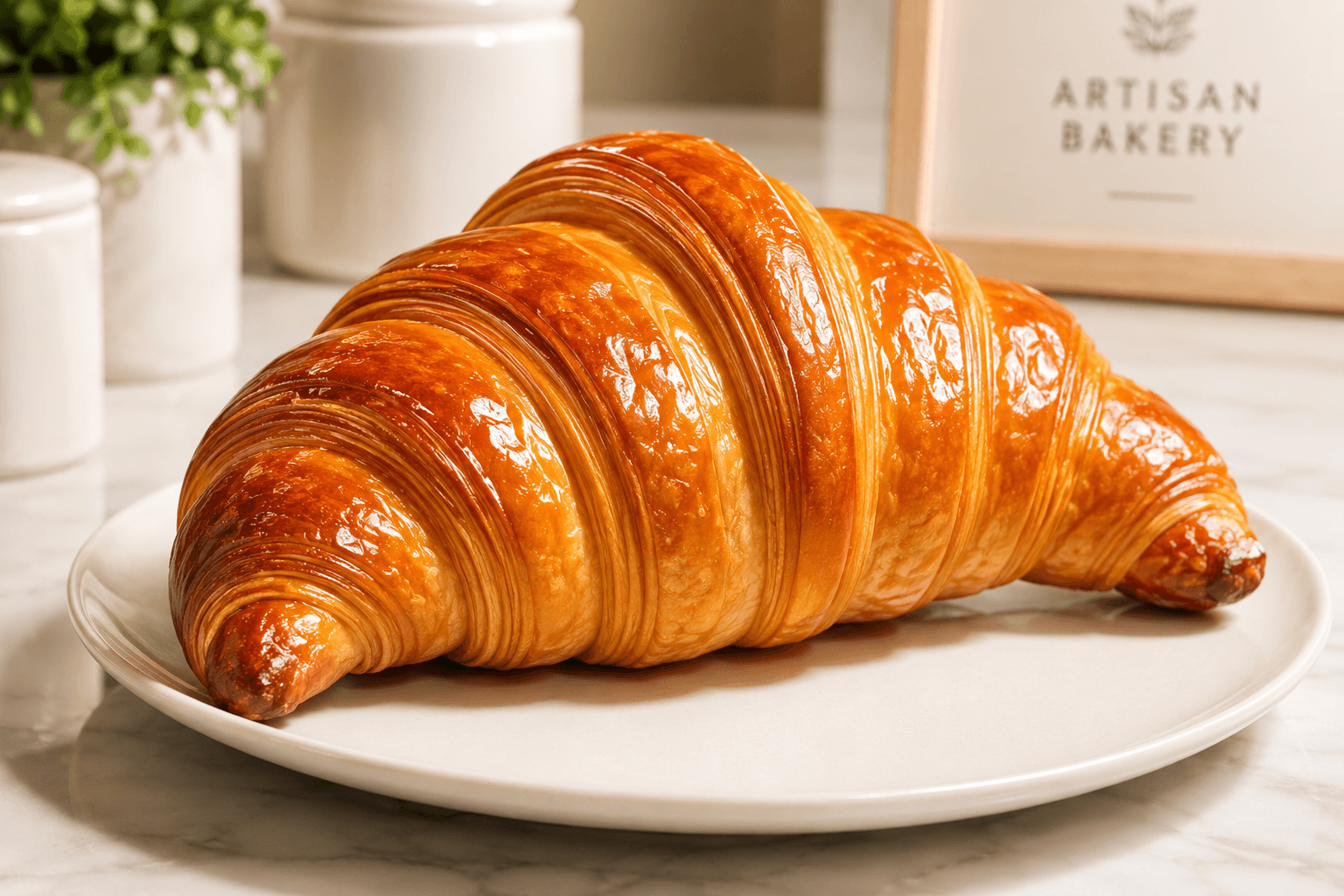
But for an independent bakery, the entire value proposition is built on the opposite premise: this is handmade, this is local, this is real. A croissant photographed with AI-perfect symmetry and a suspiciously uniform golden crust doesn’t just risk looking slightly off. It directly contradicts the brand’s central promise.
Consumer research backs this up at scale. 90% of online shoppers consider product photo quality extremely or very important to their purchase decision, and 67% rank image quality above product descriptions and reviews. Food platforms have already drawn a hard line on this: DoorDash and Uber Eats both built AI tools specifically to enhance real photos, lighting, framing, background, while explicitly prohibiting AI-generated images of the food itself, because both platforms require images to accurately represent what the customer will actually receive.
For a bakery, the stakes are even more personal than a delivery app’s policy. A customer who senses something is “off” about a product photo doesn’t usually investigate why. They simply trust the bakery a little less, and move on to the next option in their feed.
The diagnostic question worth asking
Here’s a useful exercise. Look at the product photos currently on your bakery’s Instagram, website, or menu. For each one, ask: is this a photograph of something that actually came out of my oven, or is this an image generated to represent something like it?
If the honest answer is “generated,” ask a second question: does this image hold up to close inspection? Crumb structure, glaze texture, the slightly uneven char on a baked good: these are the details where AI-generated images most often reveal themselves, even to viewers who couldn’t articulate what looked wrong.
If you’re not certain whether a photo would survive that scrutiny, that uncertainty is itself useful information. It means the photo is operating in the valley: close enough to real to invite comparison, not close enough to survive it.
What to do instead
None of this means AI has no place in a bakery’s visual content. The research consistently draws the same line: AI works well for environments, backgrounds, and conceptual or seasonal graphics, anywhere a customer doesn’t expect documentary realism. It becomes a liability specifically when it tries to replace a photograph of the actual product.
The practical implication is simple, even if it’s not always convenient: photograph the real bread, the real pastry, the real cake. Where AI genuinely helps, cleaning up a background, adjusting lighting, building a seasonal graphic around a real product photo, it can be a useful tool. Where it tries to invent the food itself, it’s working against the one thing an independent bakery has that no AI image can fake: an actual product, made by actual hands, that morning.
The uncanny valley isn’t a reason to fear AI. It’s a precise explanation of where the line is, and for a business whose entire brand depends on authenticity, that line is worth knowing exactly where it falls.
At Strategy for Bakeries, we help independent bakery owners build a digital presence that reflects the authenticity of what they actually make, without falling into the traps that quietly erode customer trust. If you’re not sure whether your current content is helping or hurting that trust, send us an email.