Why do small bakeries fail? Ask most people and they’ll name the usual suspects: a recipe that never quite landed, a street with no foot traffic, a neighborhood that couldn’t support one more croissant shop. The research on why independent food businesses close points somewhere less obvious, and it begins by correcting a number that’s been repeated for years.
Great bread is necessary. Interviews with owners who closed a restaurant suggest it’s nowhere near enough. The five patterns below describe how a bakery with a genuinely good product can lose ground without anything going wrong in the oven.
Table of contents
- What the research says about why independent food businesses close
- A concept that stops at the food
- A presence that could belong to any bakery in town
- Marketing that only happens when the oven is quiet
- A reputation that never leaves the neighborhood
- Going quiet while customers decide whether to wait
- What changes once the door matters as much as the bread
What the research says about why independent food businesses close {research}
The line everyone repeats says nine out of ten restaurants fail in their first year. Tian Luo and Philip Stark analyzed two decades of Bureau of Labor Statistics data on 81,000 full-service restaurants in the western US and found that 17% of independent startups closed in year one. H.G. Parsa and his colleagues counted any change of ownership in Columbus, Ohio, and landed closer to a quarter. The two numbers differ in part because they define failure differently, and both sit far from ninety.
Bakeries get no free pass in that data. In Parsa’s Columbus permits, the subs-and-bakeries segment had a three-year ownership turnover of about 77%, second only to Mexican restaurants. That figure counts every change of owner, retirements included, and it comes from one city in the late 1990s, so treat it as a signal. It does show the question is a live one for a bakery.
To find out why places closed, Parsa’s team interviewed twenty full-service restaurant owners who had kept their doors open for five years and twenty who had closed one. Their conclusion leaned on internal factors: the owner’s skills, time, money, and focus. Poor quality control appeared on the failed owners’ lists too, so the product matters. But one finding matters most for a bakery with a good one. The authors wrote that the failed owners “all offered high-quality foods, but that did not make them successful.”
What separated the two groups sat mostly outside the oven: a concept that went beyond the menu, and enough time and attention to run the place. Money and management close plenty of food businesses too. This list covers a different part of the picture, the one that’s easy to miss while you’re busy running the place.
The five patterns below are our reading of those findings for a bakery. Each starts from something the research documented, and the examples that follow, from captions to August closures, are our application of it, not something the study measured.
Try this before reading on:
- Describe your bakery in two sentences without naming a single product.
- Search your bakery’s name on your phone as if you’d never been inside. What would a stranger conclude in five seconds?
- Think about the last person who found your bakery for the first time. Did they see something online, or just happen to walk past?
If any of those came slowly, the next five sections show where the answer tends to get lost.
1. A concept that stops at the food
Open a bakery’s bio and the description is usually a menu in sentence form: fresh bread, pastries, cakes, coffee. Any bakery nearby could sign it.
In Parsa’s interviews, the owners who stayed open could explain a concept that reached employees, customers, and everyday decisions. The owners who closed described their cuisine and little else. Planning didn’t separate the two groups: the study found few differences in having a well-defined strategy, and considerable differences in how clear the concept was.
A concept works as a filter. It tells an owner what to say yes to, which hours to keep, what a caption should sound like, which customer the room is built for. Without one, every decision gets made on its own, and the business slowly stops adding up to anything. One failed owner in the study described trying something new each time things got hard until there was no concept left.
The bread stays excellent the whole time, which is why the drift is so hard to see from inside. The same trap shows up in cafés, where quality quietly becomes the entry requirement instead of the reason anyone picks one over another.
2. A presence that could belong to any bakery in town
Pastry photos with no point of view, captions that describe the product, a feed that looks clean and says nothing a competitor couldn’t say too. Swap the handle and nobody would notice.
Parsa’s list of closure factors includes becoming everything to everyone, and a failure of differentiation. The numbers add context: failure ran highest in the ZIP codes with the most restaurants. The authors’ background discussion ties crowded clusters to exactly this problem: a place that can’t show customers what makes it different has a hard time competing with the ones next to it.
Here’s why a generic presence costs more in a crowded market: when two bakeries look and sound alike, price and proximity end up deciding more than they should. The bakery with the better croissant and the same feed as its neighbors loses that choice before the croissant ever comes up.
3. Marketing that only happens when the oven is quiet
The pattern looks like this: five stories during a busy weekend, then two weeks of silence while payroll, inventory, and a broken mixer take over.
Parsa’s interviews show how much bigger that squeeze can get. Every failed owner brought up the sheer time a restaurant demands, and the authors wrote that failure seemed to stem in large part from an inability or unwillingness to give the business enough attention, whether from lack of time, passion, or knowledge. Constant Contact’s 2024 survey of more than 1,300 small business decision-makers found that 56% have an hour or less a day for marketing and 52% routinely put it off.
Marketing goes first because the kitchen’s demands arrive with a clock attached, and the payoff from a post lands weeks later, if it can be traced at all. When the same hours are competing, the one with a clock on it wins, which leaves communication clustered around the busy days and thin in the slow stretches, when a bakery could use new faces.
4. A reputation that never leaves the neighborhood
Plenty of bakeries are genuinely loved. Regulars come weekly, the line forms on Saturday morning, and the owner reads the line as proof the business works. For the people already inside it, it does.
Parsa’s successful owners credited relationships in the community over advertising, and the authors concluded that a restaurant has to be perceived as part of its community. Those interviews date from 2004. Michael Luca’s study of Seattle restaurants from 2003 to 2009 tracked what happened next: a one-star increase in Yelp rating raised revenue 5 to 9% for independent restaurants and had no effect on chains, and chains lost market share as Yelp spread. Luca read that as online reviews substituting for older forms of reputation.
Here’s why it lands on independents: a chain’s name tells a newcomer what to expect before they walk in. An independent has no name doing that work, so the information has to come from somewhere else, and online it comes from whatever a newcomer can find in the minute before deciding.
A loyal following measures how happy the people who found you are. It says nothing about the people who never did.
5. Going quiet while customers decide whether to wait
One of the closure factors in Parsa’s list reads like a small story. A restaurant closed for a major renovation and never told its customers why, or when it would reopen. By the time the doors opened again, the study notes, the customers were long gone.
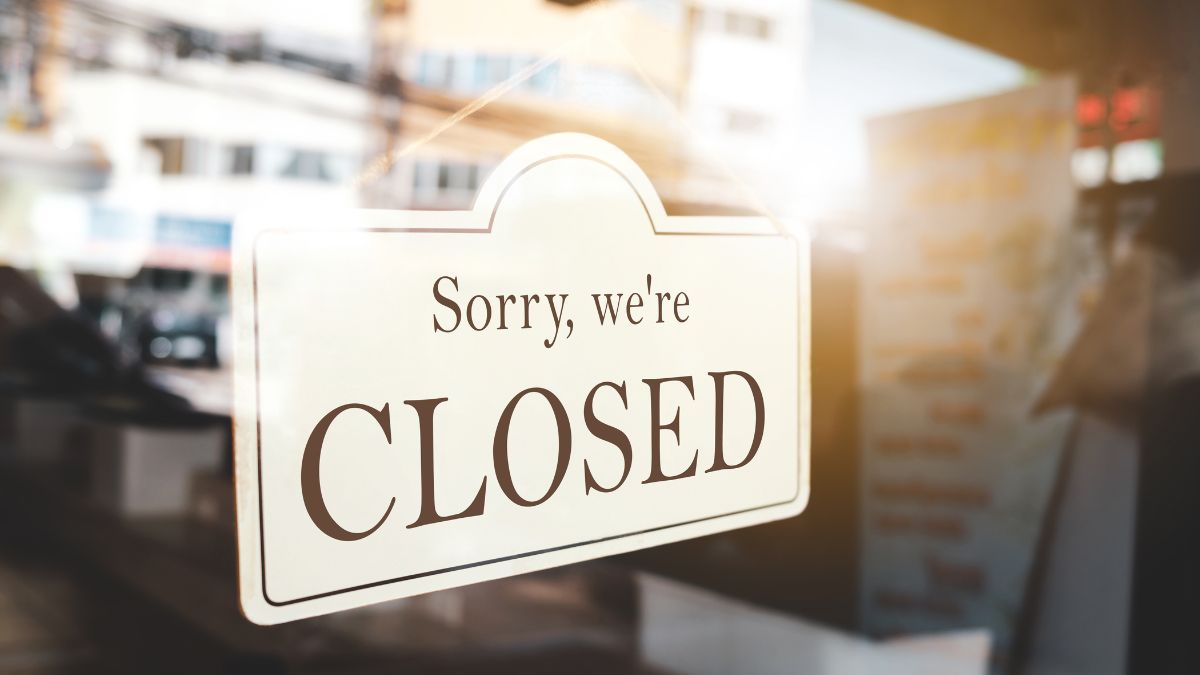
Bakeries close for smaller reasons: a two-week break in August, a new oven, a slow January, holiday hours that change every year. The study didn’t look at those, but the moment is the same at a smaller scale: a regular finds a closed sign and has to decide whether to wait or go somewhere else.
The silence costs so much because a closure with no explanation and no date leaves the decision entirely to the customer, and a competitor may be a few blocks away. The bread is exactly as good on the day the doors reopen. The open question is whether anyone is still waiting for it.
What changes once the door matters as much as the bread
Bread gets judged after someone walks in. Almost everything on this list happens before that, in the minutes when a stranger decides whether to walk in.
Perfecting a laminated dough or sourcing better flour was never wasted effort. That work is the reason a bakery has something worth finding in the first place.
To someone who hasn’t walked in yet, a bakery is whatever they can piece together in a minute: the concept, the feed, the latest post, the reviews, the sign on the door. Whatever the oven produces, that minute decides whether they ever find out.
The distance between a product that’s ready and a business that can be read in that minute is hard to see from behind the counter. It’s the part we work on at Strategy for Bakeries.
Strategy for Bakeries helps independent bakeries see themselves the way a stranger does, before anyone tastes anything. If you’d like to see yours from the sidewalk, send us an email.